Can any of you do this for Bayesian statistics, for e.g. line fitting? If you can and do, you get an A+, automatically.
Friday, April 13, 2012


Thursday, April 12, 2012
CA1 modification
Based on feedback from Wednesday night's help session, it looks like I underestimated the time necessary to complete the class activity (in true professorial fashion). I forgot that problems 6 and 7 required derivations and that many of you have yet to learn LaTeX, and that problem 8 is nontrivial.
Here's the new plan:
Turn in problems 1-5 at the beginning of class Friday. We'll then spend Friday's class talking about LaTeX and working on fitting lines.
Here's the new plan:
Turn in problems 1-5 at the beginning of class Friday. We'll then spend Friday's class talking about LaTeX and working on fitting lines.
Wednesday, April 11, 2012
Handy LaTeX References
Learning how to write in LaTeX is a valuable skill to learn early in your scientific career. Don't be that guy/gal who writes their papers in Word. Ugh!
LaTeX Math Symbols:
Handy online LaTeX editor (click buttons for examples of code):
(also, check the URLs for all of the equations in the previous post for the LaTeX used to create them).
How to pronounce and write "LaTeX":
http://en.wikipedia.org/wiki/LaTeX#Pronouncing_and_writing_.22LaTeX.22
I prefer "lay-tech" but I won't make fun of you if you say "lah-tech." I will make fun of you if you say "lay-teks" :)
Tuesday, April 10, 2012
Integrating exponentials
Often in physics, and sometimes in life, you come across the need to integrate an exponential of the form
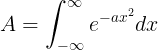
Allow me to show you how to handle this using simple dimensional analysis rather than calculus and memorization. Dimensional analysis can get you out of a bind when working on a plane (sans wireless), in an oral exam or even during Q&A after your colloquium!
First, note that the units of A must be the same as the units of x since exponentials are dimensionless and dx has units of x. Further, examination of the quantity in the exponent reveals that a must have units of 1/x^2, since the argument of an exponential must be dimensionless, too. Thus, the integral must have units of x and involve a, like so:
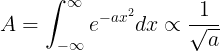
This is most of the way there. It turns out that there's a missing factor of the square-root of pi:
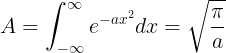
But I think it's pretty cool that you can get to within a factor of root-pi (1.77) without any calculus! I can pretty easily remember the pi part after I get the dimensions correct. Even if I forget, being within a factor of two is good enough for astronomy in most applications.
You might notice that this is the form of the Gaussian function, centered on x=0 with

Once normalized, the Gaussian function becomes the normal distribution so frequently used in data analysis (and CA1). Note the distinction between a Gaussian function and a normal distribution. The difference is important, but frequently ignored in the scientific literature. For example, a Gaussian has three free parameters. A normal distribution has only two. And only one of these is a proper probability distribution function (pdf).
For more "Street Fighting Mathematics" like this, check out this book.
Allow me to show you how to handle this using simple dimensional analysis rather than calculus and memorization. Dimensional analysis can get you out of a bind when working on a plane (sans wireless), in an oral exam or even during Q&A after your colloquium!
First, note that the units of A must be the same as the units of x since exponentials are dimensionless and dx has units of x. Further, examination of the quantity in the exponent reveals that a must have units of 1/x^2, since the argument of an exponential must be dimensionless, too. Thus, the integral must have units of x and involve a, like so:
This is most of the way there. It turns out that there's a missing factor of the square-root of pi:
But I think it's pretty cool that you can get to within a factor of root-pi (1.77) without any calculus! I can pretty easily remember the pi part after I get the dimensions correct. Even if I forget, being within a factor of two is good enough for astronomy in most applications.
You might notice that this is the form of the Gaussian function, centered on x=0 with
Once normalized, the Gaussian function becomes the normal distribution so frequently used in data analysis (and CA1). Note the distinction between a Gaussian function and a normal distribution. The difference is important, but frequently ignored in the scientific literature. For example, a Gaussian has three free parameters. A normal distribution has only two. And only one of these is a proper probability distribution function (pdf).
For more "Street Fighting Mathematics" like this, check out this book.
Monday, April 9, 2012
Normalization
I'm sorry I wasn't able to be there in class today. However, Coco reports that you all made good progress working on Class Activity 1. She also reports that many of you struggled with the normalization part of Problem (4). Assuming this is where the problem was, allow me to help everyone along.

 \propto p(\{A\}\,|\,\mu)\ p(\mu) "\large p(\mu\,|\,\{A\}) \propto p(\{A\}\,|\,\mu)\ p(\mu)")
In order for this to be an equation, you have to normalize it. You might want to convince yourself that the quantity on the right hand side is not normalized by integrating over all values of \mu. In fact, dividing by this integrated quantity provides the normalization constant:
 =\frac{p(\{A\}\,|\,\mu)\ p(\mu)}{\int_{-\infty}^{\infty} p(\{A\}\,|\,\mu)\ p(\mu) \rm{d}\mu} "\large p(\mu\,|\,\{A\}) =\frac{p(\{A\}\,|\,\mu)\ p(\mu)}{\int_{-\infty}^{\infty} p(\{A\}\,|\,\mu)\ p(\mu) \rm{d}\mu}")
The denominator is also known as the "evidence":
 =\int_{-\infty}^{\infty} p(\{A\}\,|\,\mu)\ p(\mu) \rm{d}\mu "\large p(\{A\}) =\int_{-\infty}^{\infty} p(\{A\}\,|\,\mu)\ p(\mu) \rm{d}\mu")
or the probability of the data given the model, with \mu marginalized out.
The actual value of the integral can be expressed analytically, or you could just do it numerically. Or you can use WolframAlpha. But whatever you do, don't get too hung up on this! :)
Problem (4) states:

Without properly normalizing things, you will end up with a proportionality of the form:
In order for this to be an equation, you have to normalize it. You might want to convince yourself that the quantity on the right hand side is not normalized by integrating over all values of \mu. In fact, dividing by this integrated quantity provides the normalization constant:
The denominator is also known as the "evidence":
or the probability of the data given the model, with \mu marginalized out.
The actual value of the integral can be expressed analytically, or you could just do it numerically. Or you can use WolframAlpha. But whatever you do, don't get too hung up on this! :)
Wednesday, April 4, 2012
Ay117: Starting anew in 2012
Welcome to the new class of AstroStats students!
The (rough) course syllabus can be found here:
http://www.astro.caltech.edu/~johnjohn/astrostats/
I'll update this syllabus soon, but all of the key points that I covered in the first class today are there.
The first Class Activity is also available. I will post the activities on the right hand side of this blog throughout the term. We'll work on this activity starting Friday morning, and we'll continue through next week. Whatever we don't finish by the end of class Monday will be homework due Friday, unless otherwise specified.
The reading assignment is Chapters 1 and 2 of Sivia (link to Google Books). Once you finish Chapter 2, keep going. The standing reading assignment is all of Part I, to be completed before week 3 of class. Once you read Part I, read it again.
The (rough) course syllabus can be found here:
http://www.astro.caltech.edu/~johnjohn/astrostats/
I'll update this syllabus soon, but all of the key points that I covered in the first class today are there.
The first Class Activity is also available. I will post the activities on the right hand side of this blog throughout the term. We'll work on this activity starting Friday morning, and we'll continue through next week. Whatever we don't finish by the end of class Monday will be homework due Friday, unless otherwise specified.
The reading assignment is Chapters 1 and 2 of Sivia (link to Google Books). Once you finish Chapter 2, keep going. The standing reading assignment is all of Part I, to be completed before week 3 of class. Once you read Part I, read it again.
Subscribe to:
Posts (Atom)